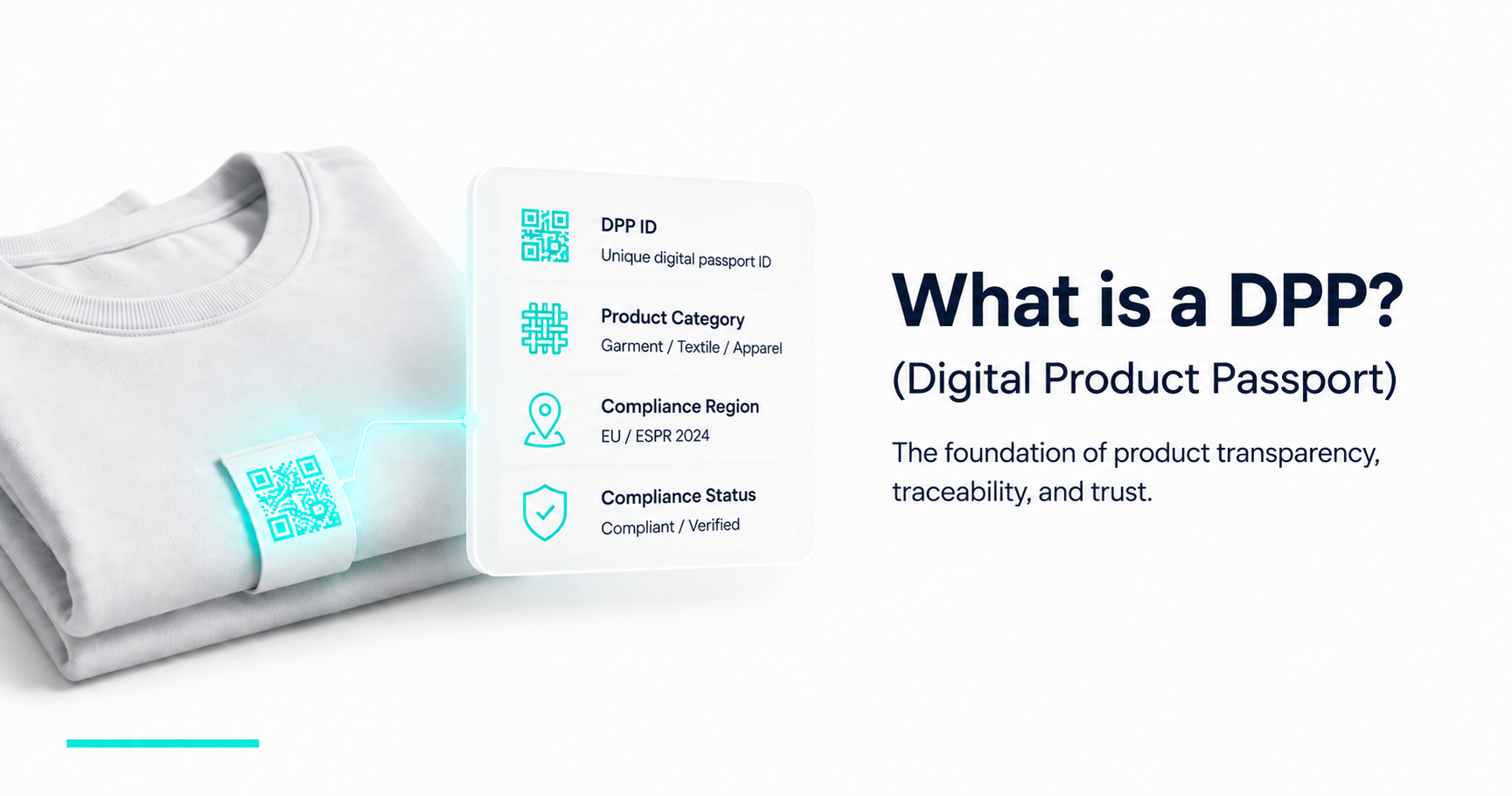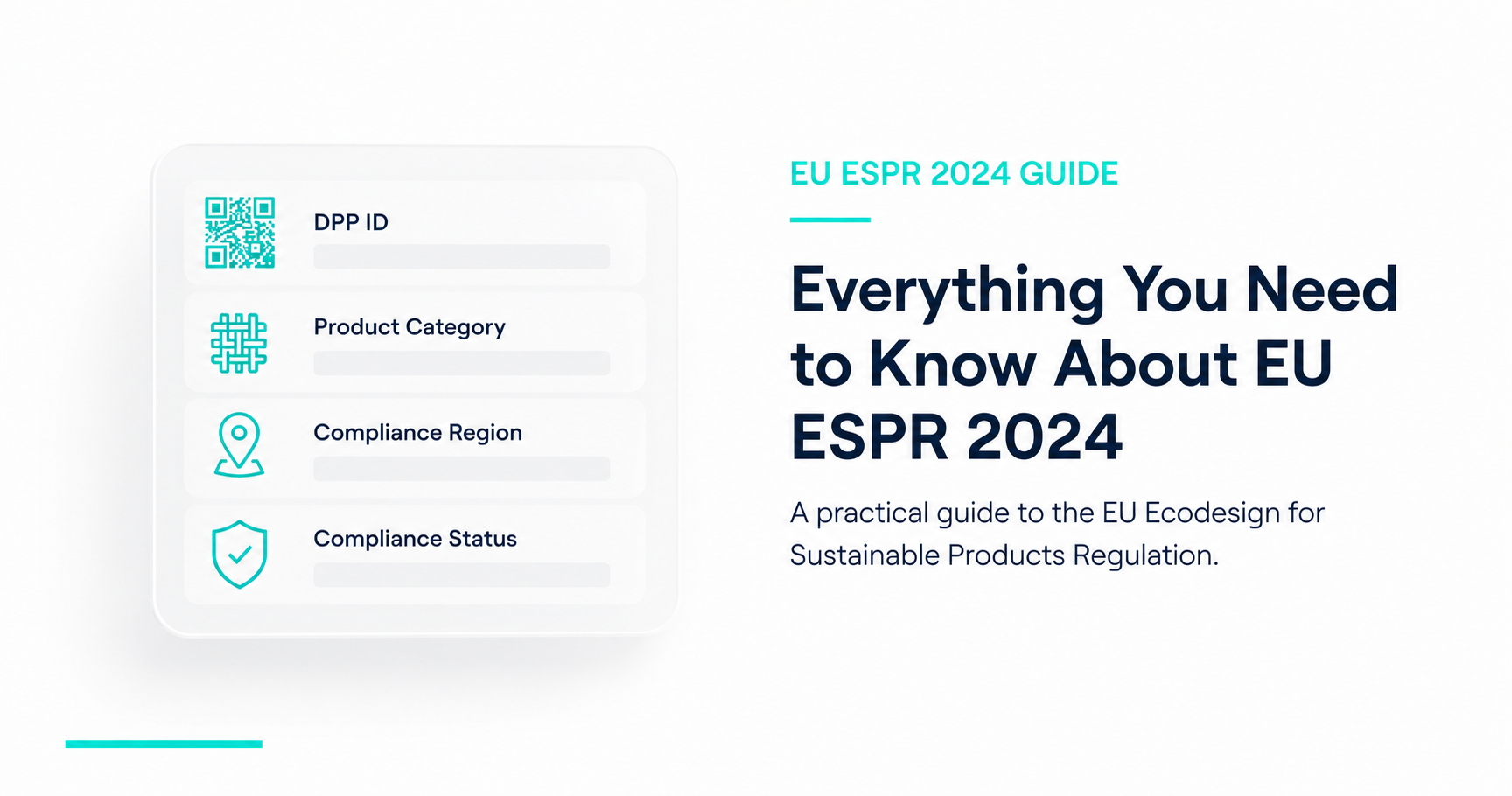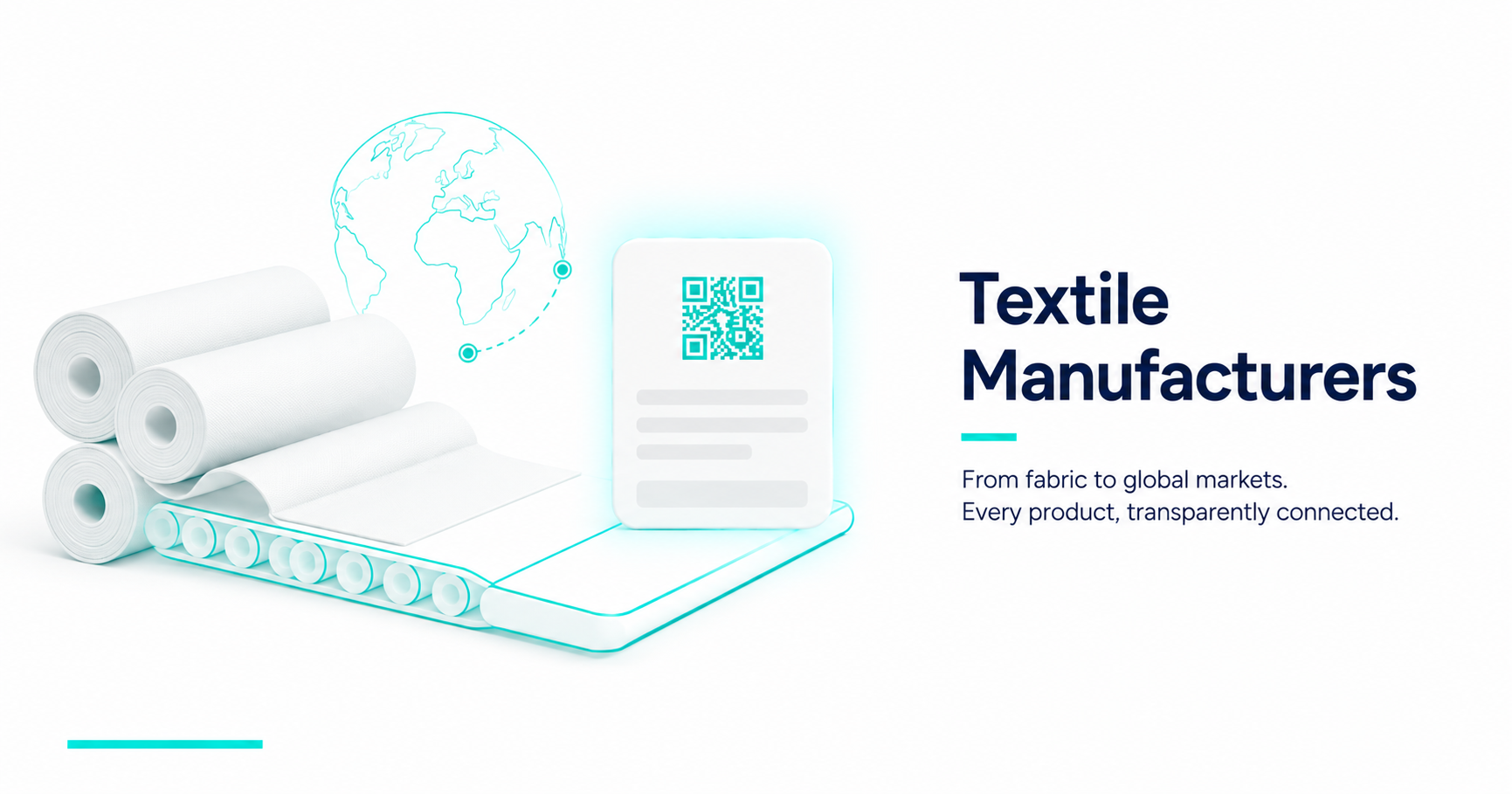
For a textile manufacturer, a Digital Product Passport is a digital record — reached by scanning a QR code on the garment or its packaging — that documents materials, origin, and supply-chain journey to meet EU ESPR requirements. Textiles and apparel are named as a priority category under ESPR, which means manufacturers exporting into the EU are expected to have passport-ready data before category-specific rules are formally phased in, currently anticipated from around 2027.
Why Are Textile Manufacturers a Priority Category Under ESPR?
The EU singled out textiles because of the sector’s environmental footprint and its historically opaque supply chains — a garment can pass through cutting, sewing, dyeing, and finishing across several countries before it reaches a retailer, and almost none of that journey is currently visible to the end customer or regulator. A passport forces that journey into a structured, checkable record. It also underpins the circular-economy objectives the regulation is built around: a recycler can only process a garment correctly if it knows what the garment is made of, and a resale platform can only price it fairly if provenance can be verified rather than asserted. For the full regulatory overview, read EU ESPR 2024 explained.
What Supply-Chain Data Does a Textile DPP Actually Need?
Exact fields will be set by the textile delegated act, but the categories are already visible across ESPR guidance and industry pilots:
- Fibre composition: the material breakdown by percentage, including recycled content where claimed.
- Origin and tier data: where the garment was cut and sewn, and — progressively — where the fabric was milled and the fibre sourced.
- Certifications: commonly referenced schemes such as GOTS and OEKO-TEX, attached as evidence rather than as a logo.
- Chemical and process information: dyeing and finishing treatments, and any substances of concern.
- Care, repair and durability: how the garment should be maintained and what repair routes exist.
- End-of-life instructions: how the product should be disassembled, recycled, or disposed of.
How Do Textile Exporters Prepare Supply-Chain Data?
The practical route is tier by tier, not all at once. Start with Tier 1 — the cut-and-sew unit, which is data you already hold. Then map Tier 2, the fabric mills and processing units you buy from, and finally Tier 3, the raw material and fibre source. Most exporters find the exercise reveals two things quickly: which suppliers can already produce structured data on request, and which relationships depend on a phone call and a scanned certificate. That gap is the real project. Naming an internal owner for passport data — someone accountable for keeping it current as materials change — matters more at this stage than choosing software. See our solutions for manufacturers for how multi-tier workflows fit together.
Do Non-EU Textile Exporters Need a DPP?
Yes — if the product is placed on the EU market. The obligation attaches to market placement, not to where the manufacturer is based, which means an Indian, Bangladeshi, or Turkish exporter shipping into the EU is inside scope even though the regulation is European. More immediately, EU retail buyers are already starting to ask exporters for passport-ready data as a condition of the relationship, independent of the regulatory deadline, because they’re managing their own compliance risk. For Indian and other non-EU textile exporters, the practical timeline isn’t the delegated act date — it’s the point at which a key buyer asks for it, which is arriving earlier than the regulation itself.
See how StableDPP works for textile exporters →
How Can a Manufacturer Start Without a Full ERP Overhaul?
You don’t need to integrate a DPP platform with your ERP to start. Most manufacturers begin with a self-serve platform, entering data product-by-product or in a batch upload, which is enough to issue real, verifiable passports for a pilot range. That lets a factory prove the workflow — what data is easy to get, what’s missing, who owns collecting it — before investing in any system integration. ERP or PIM integration becomes worthwhile once passport volume is high enough that manual entry is the bottleneck, not before. To see what a self-serve starting point costs, read the pricing guide.