Most exporters we speak to have already had three or four software demos. Every platform shows a QR code, a nice product page and a dashboard. From the outside they look the same.
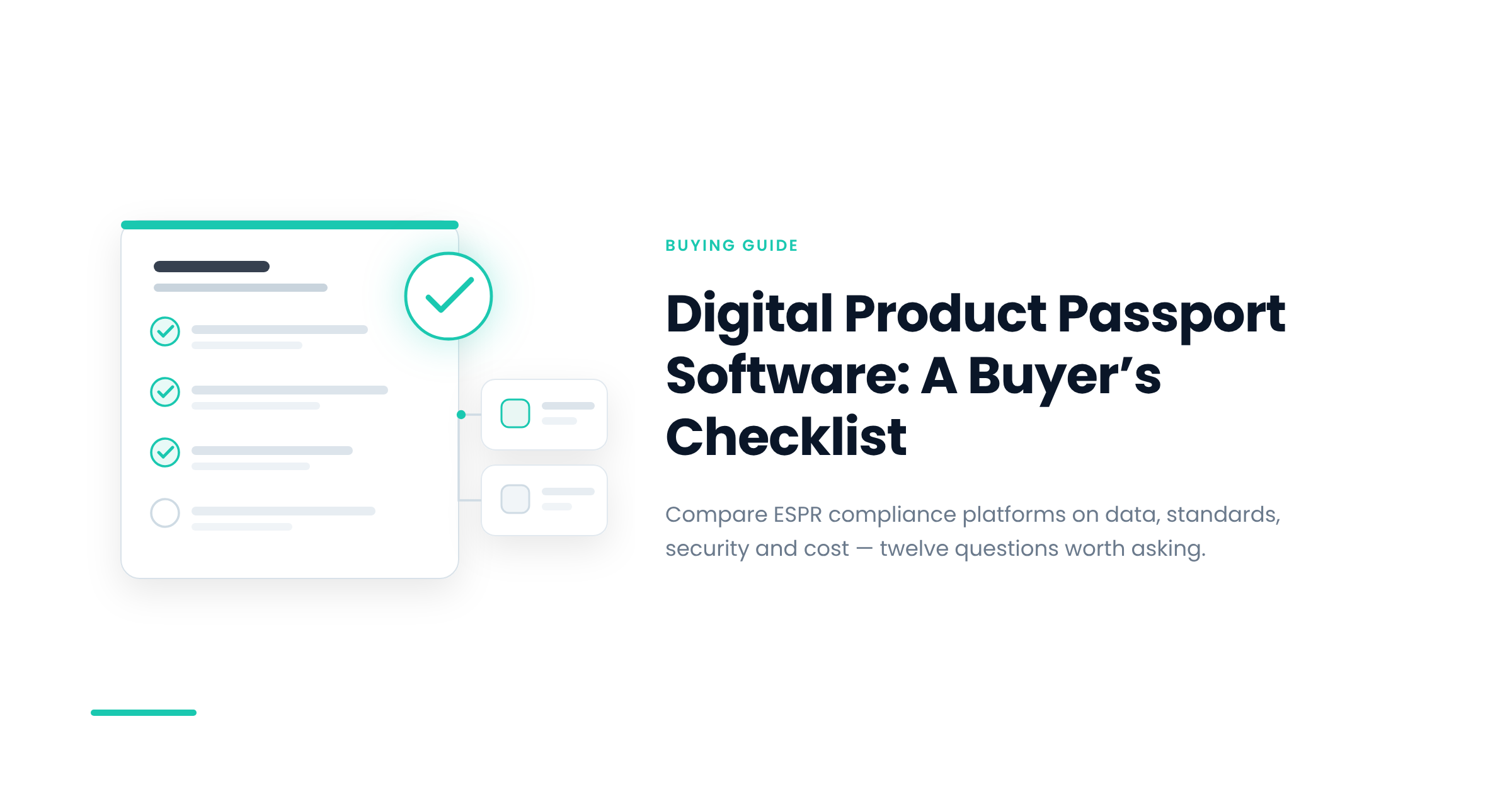
They are not the same. The differences sit underneath, in how a platform collects supplier data, which standards it follows and whether its records can be trusted by an EU buyer. This checklist is the set of questions we would ask if we were on your side of the table.
What Does Digital Product Passport Software Actually Do?
A Digital Product Passport is a structured, machine-readable record of a product, reached by scanning a data carrier such as a QR code. The software behind it does four jobs: it collects product data from your team and your suppliers, structures it into the fields EU rules will require for your product group, publishes it behind a unique identifier and a data carrier on the product, and protects it so the record stays accurate, available and access-controlled for as long as the product is on the market. If a tool only does the third job, it is a QR generator, not ESPR compliance software.
Which Data Questions Should You Ask First?
Data is where most DPP projects stall, so start here.
- How do suppliers enter data? Your spinner, dyer and processor will not log in to a complex portal. Ask whether suppliers can contribute through a simple form, a spreadsheet upload or a mobile link, and whether they need a paid seat.
- Can it reuse the certificates you already hold? GOTS, OEKO-TEX, GRS and test reports already contain much of what a textile passport will need. Good software attaches them as evidence rather than asking you to retype them.
- Does it work at batch level as well as product level? Many Indian mills produce by lot, not by SKU. The platform should let you link a finished garment back to the fabric and yarn batches it came from.
- How does it handle missing data? You will not have every field on day one. Ask how gaps are flagged, and whether you can publish a partial record internally while you close them.
Which Standards Should DPP Software Follow?
The EU wants passports from different providers to work together. The European standardisation bodies have published a family of DPP standards covering identifiers, data carriers, data exchange and access rights — our earlier post on those standards explains them in detail.
- Does it use GS1 Digital Link or an equivalent open identifier scheme? A passport tied to a vendor's private URL format is a risk. Ask how identifiers are issued and whether they resolve without the vendor. See our guide to GS1 Digital Link.
- Can your data be exported in an open, machine-readable format? ESPR requires passports to be interoperable. If you cannot move your records to another provider, you do not fully control them.
- Does it separate public and restricted data? Consumers, repairers, recyclers and authorities will see different fields. The software should support role-based access, not one public page for everyone.
How Do You Know the Data Can Be Trusted?
An EU importer carries the legal responsibility for what it places on the market. It will want proof that your passport data has not been quietly changed after the fact.
- Is every change recorded with who, what and when? A full audit trail is the minimum.
- Is the record tamper-evident? An audit log stored in the same database the vendor controls can itself be edited. Ask how the platform proves a record is unchanged. Blockchain anchoring is one practical answer; we explain where it fits, and where it does not, in our post on blockchain and the DPP.
- Where is data hosted, and how is it backed up? Ask about hosting region, backup frequency and what happens to live passports if the vendor stops trading.
What Should You Check on Cost and Support?
- How is pricing structured? Per product, per SKU, per scan or per supplier seat can produce very different bills at export volumes. Model your real catalogue before you sign. Our breakdown of Digital Product Passport cost covers the main pricing models.
- Who helps you onboard suppliers? Software alone does not fill a passport. Ask whether the vendor offers onboarding support, supplier training in regional languages, or a managed service.
Which Red Flags Should End a Demo Early?
- The vendor says the EU requires blockchain. It does not.
- The vendor claims to be "ESPR certified." No such certification exists for software today.
- Final textile data fields are presented as settled. The textile delegated act has not yet been adopted.
- There is no export function, or export costs extra.
What Should Indian Exporters Do Next?
Pick three products that go to your largest EU buyer. Run them through two shortlisted platforms with real supplier data, not demo data. The platform that gets your suppliers to contribute without a phone call from you is usually the right one. If you want to see how StableDPP handles these twelve questions, you can create a sample passport for one of your products, or read how the platform works on our product page.
Book a demo — see how StableDPP answers these twelve questions →